Our own product
Open Lance: a marketplace that charges freelancers nothing
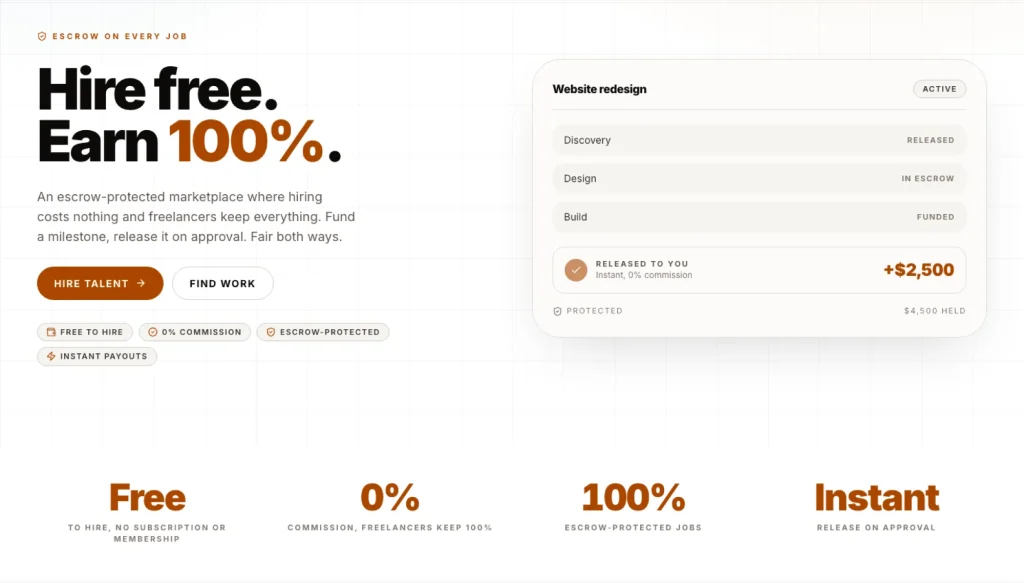
Freelance marketplaces take between five and twenty percent of what a freelancer earns, and often hold the money for days after the client has approved the work. We built one that does neither. Open Lance is live at openlance.io.
- Owner
- Brilliant Systems, our own product
- Status
- Live at openlance.io
- Built around
- Escrow on every job, release on approval
The challenge
Both sides of a marketplace are asked to trust first.
A freelancer starts work on a promise that the client has the money and will pay. A client pays on a promise that the work will arrive. Whichever side moves first is exposed, and the platform usually charges for standing in the middle.
The usual charge is commission, taken from every job whether or not anything goes wrong. On a long engagement it is often the largest single deduction a freelancer faces.
Bidding systems add to it. When the cost of a proposal rises with the value of the contract, the freelancers who can afford to bid on big work are the ones who already have money.
What we built
Committed before the work, released on approval.
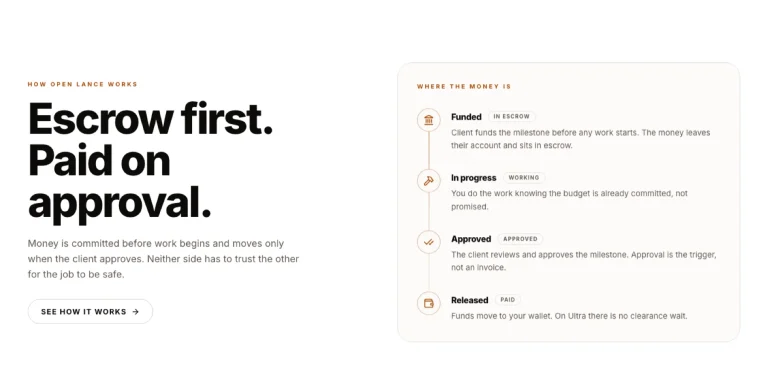
The whole design turns on this sequence. Because the money moves into escrow before anything begins, neither side has to trust the other for the job to be safe.
-
1
Funded
The client funds the milestone before any work starts. The money leaves their account and sits in escrow.
-
2
In progress
The freelancer works knowing the budget is committed rather than promised.
-
3
Approved
The client reviews and approves. Approval is the trigger, not an invoice.
-
4
Released
Funds move to the freelancer in full, instantly where both sides have agreed to instant release. No commission is deducted at any point.
The product
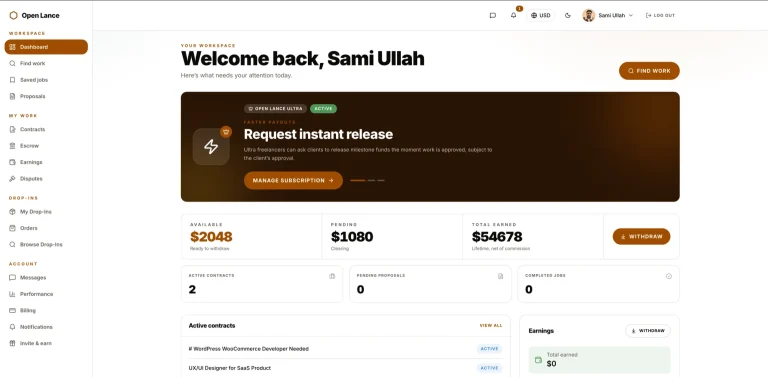
What it actually looks like.
openlance.io
openlance.io
openlance.io
openlance.io
How we approached it
Move the money first, and stop charging for the work.
-
01
Escrow before anything starts
The client funds the milestone before work begins. The money leaves their account and sits in escrow, so the freelancer can see it is committed rather than promised.
-
02
Approval is the trigger
Payment is released when the client approves, not when an invoice is raised and chased. Where both sides agree to instant release, the money reaches the freelancer’s wallet straight away.
-
03
Zero commission as a standing rule
The freelancer keeps one hundred percent of what they earn, on every job. It is not an introductory offer, because taking a cut of somebody else’s work was the thing we set out to remove. Open Lance earns from bids instead: a flat cost per proposal, or Ultra, an optional paid membership with a regular bid allowance, discounted bid packs and no clearance wait on payouts. Commission stays 0% for everyone.
-
04
One flat bid, any job size
A proposal costs one bid whether the contract is worth two hundred dollars or twenty thousand, so reputation decides who wins the work rather than who can afford to bid.
The result
Live, and running on the rules it was built on.
Open Lance is live at openlance.io. Clients post jobs, review proposals and hire without paying a fee. Every job is escrow protected, freelancers keep everything they earn, and payment is released on approval.
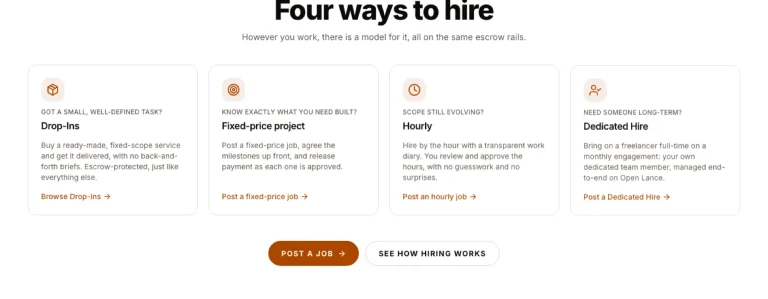
It supports four ways of hiring, from short drop-in tasks to a dedicated hire, and all four run on the same escrow, so the protection does not depend on which one a client picks.
Every marketplace says it is on the freelancer’s side. The test is what it deducts.
Why it matters
What it proves.
Trust does not need a commission
With the money in escrow and release tied to approval, neither side has to move first. The protection comes from the order the money moves in, not from a fee taken on every job.
Waiting to be paid is a choice
Holding money for days after approval is a decision a platform makes, not a law of payments. Open Lance releases on approval, and instantly where both sides agree.
We hold our own product to it
It is the clearest statement we can make about how we think platforms should treat the people doing the work, and the same care goes into platforms we build for clients.
Next step
Building a platform where money changes hands?
A senior engineer reads every enquiry and replies within one business day. Within a week you have a written approach with a cost and a time range, and a plain answer if we think you should not build it.