Plans change hourly
Programme, drawings and specification all move. Any system built around a fixed plan spends its life out of date and gets abandoned.
Construction & real estate
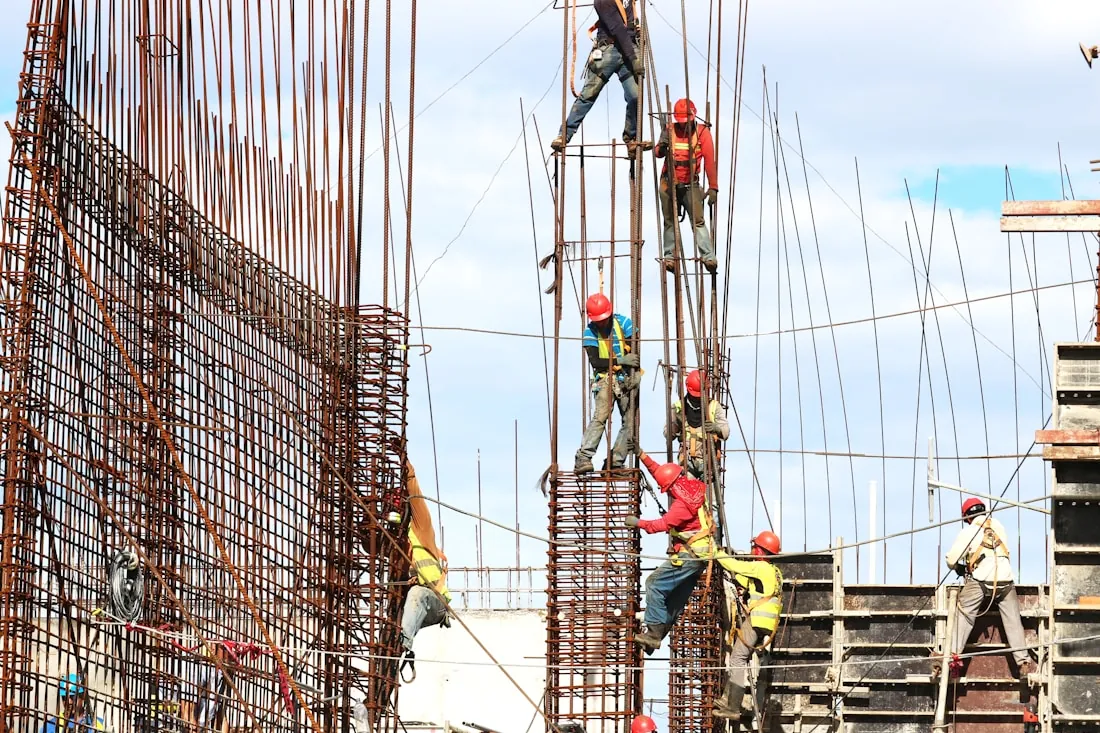
Construction software has to survive contact with a physical world that refuses to behave. Weather moves, subcontractors overrun, a delivery arrives on the wrong day, and a variation is agreed verbally at eight in the morning and written down at six that evening, if at all. Software that assumes the plan is true is software nobody on site will open twice. Construction software development has to start on site, not in the office.
“Will the people on site actually use it, with gloves on, in the rain?”
The pressure
Programme, drawings and specification all move. Any system built around a fixed plan spends its life out of date and gets abandoned.
Head office, site teams, subcontractors and suppliers, most of whom do not work for you and will not adopt your tooling because you asked.
Drawings, RFIs, variations and sign-offs are the legal record. Version confusion is not an inconvenience, it is a dispute.
Project margin is often single digit. The difference between a good year and a bad one is usually visibility of cost while there is still time to act.
Two buildings
Almost every abandoned construction platform was designed by people sitting down, indoors, with a keyboard and a stable connection. Here is the difference we build for.
What head office assumes
What site actually needs
The work
Four systems, judged on whether someone in a hi-vis jacket opens them twice.
Progress, cost and variation captured where the work happens rather than reconstructed in the office a week later.
One current version, a visible history, and a record of who approved what and when.
Mobile-first, tolerant of no signal, designed for a gloved hand and a bright screen. Data syncs when the phone finds a network again.
For the operators rather than the builders: maintenance, occupancy, compliance and lifecycle cost across a portfolio.
We hired Brilliant Systems to develop a custom AI-powered system that could improve project forecasting, monitor real-time site activity, and enhance safety compliance across multiple construction sites. … Post-implementation, we saw a significant improvement in how quickly and accurately we could identify bottlenecks.
Non-negotiable
Where AI actually lands
Worth doing
Where we stop
Any automated action with a safety consequence, and anything that signs on your behalf. A model can flag a hazard; a person decides what happens next. Approval is a human act with a name attached, and that is exactly what a dispute turns on.
Evidence
HOCHTIEF, Superior Bau and JAKO Bau are on our client wall. For Constec (Construction & Design S.A.E) we built an AI monitoring system used across several construction sites, integrated with their existing project management software.
How we deliver it
Native and cross-platform builds that pass review the first time.
Platforms that hold up under real load, real compliance, and real headcount.
Systems built for one business, owned outright, with no licence renewal attached.
Other sectors we work in
Next step
A senior engineer reads every enquiry and replies within one business day with an honest view of what it will take, including what the people on site will actually use.
Certified, partnered and awarded











1/7
Discuss your project
Seven short questions. About 90 seconds. A senior engineer reads your answers before we reply. No sales sequence, no newsletter. Just a thoughtful response about what comes next.
Start here
Choose the one that comes closest.
The problem
A sentence or two is enough. Tell us what isn’t working today or what you want to make possible.
Where you are today
Choose everything that applies.
Timing
A real deadline changes how we approach the work. If there isn’t one yet, that’s useful to know too.
Scope
A range is enough. It helps us understand the right approach and team for the problem. It does not determine what we charge.
Your team
This helps us understand whether we should lead the engineering, work alongside your team, or advise your existing engineers.
Stay in touch
A senior engineer will read what you’ve shared and respond within one business day.
How would you prefer to continue?
Received
A senior engineer will review what you’ve shared and come back with the most useful next step.