OT and IT do not mix easily
Operational technology has different priorities, different lifespans and, correctly, different attitudes to risk than the IT department.
Manufacturing & industrial
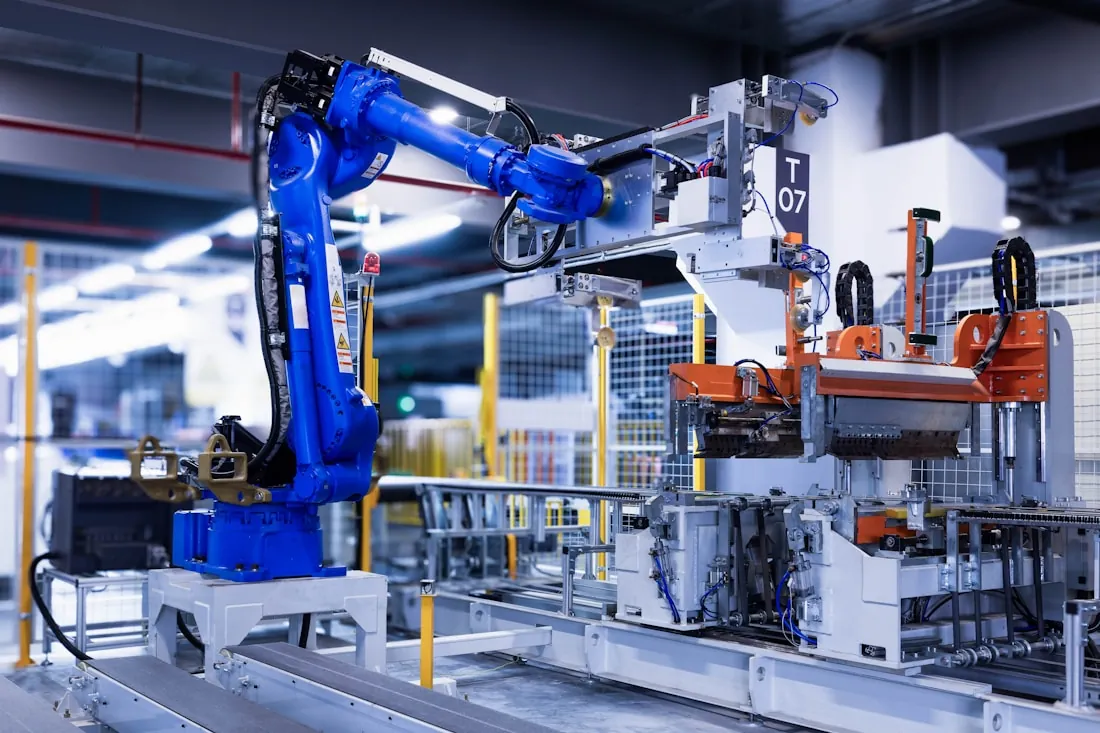
Industrial software lives next to machinery that is older than the software industry, speaks protocols designed before the internet, and cannot be restarted because someone wants to ship a feature. The engineering constraint is not the model or the interface. It is that the physical process is authoritative and your system is a guest in its building. Manufacturing software development has to start from that fact.
“Can you integrate without touching what is already running?”
The pressure
Operational technology has different priorities, different lifespans and, correctly, different attitudes to risk than the IT department.
An hour of stopped line is measured in real money, which sets the risk appetite for every change you propose.
Machines have produced telemetry for years. Most of it goes nowhere and is retained for days.
The people who know why the process works the way it does are leaving, and it is not written down anywhere.
The work
Four systems, none of which is permitted to stop the line.
Real production state, not the state the planning system believes, surfaced where supervisors can act on it.
Moving from fixed-interval servicing to condition-based, using the telemetry the machines already produce.
Batch, lot and component traceability that answers a recall question in minutes rather than weeks.
Connecting what the ERP believes to what is physically happening, which is usually where the discrepancy lives.
Operational Continuity: Phased infrastructure upgrades and maintenance were carried out with minimal disruption, keeping operations running smoothly throughout.
Read-only first
Software that can affect a physical process starts by not affecting it. Every phase below has an exit condition that the plant agrees to, and we do not move on without it. The durations are typical, and confirmed in writing once scope is agreed.
We tap existing telemetry through a one-way boundary. No writes, no control, no new hardware on the control network. Exit condition: our numbers match what the plant already believes.
Dashboards for supervisors showing real production state rather than planned state. Exit condition: the plant uses our screen instead of the whiteboard, unprompted.
Condition models raise maintenance recommendations to a person who accepts or rejects them. Exit condition: acceptance rate high enough that the plant trusts the queue.
Only now does anything write back, only to systems agreed in writing, and always behind the existing safety interlocks. Exit condition: a documented rollback that the plant has executed once as a drill.
Non-negotiable
Where AI actually lands
Worth doing
Where we stop
Closed-loop control of a physical process without hard safety interlocks. The engineering discipline that governs machinery predates this technology and is not going to relax for it.
Evidence
We are early in this sector and would rather say so than dress up an adjacent project as a manufacturing reference. The review quoted above comes from cloud infrastructure work, not from a production line.
How we deliver it
Platforms that hold up under real load, real compliance, and real headcount.
Production ML pipelines, retrieval systems, and evaluation harnesses built to survive audit.
Pipelines, infrastructure as code, and deploys that stop being an event.
Other sectors we work in
Next step
A senior engineer reads every enquiry and replies within one business day with an honest view of what it will take, including what we would observe before anything is allowed to change.
Certified, partnered and awarded









1/7
Discuss your project
Seven short questions. About 90 seconds. A senior engineer reads your answers before we reply. No sales sequence, no newsletter. Just a thoughtful response about what comes next.
Start here
Choose the one that comes closest.
The problem
A sentence or two is enough. Tell us what isn’t working today or what you want to make possible.
Where you are today
Choose everything that applies.
Timing
A real deadline changes how we approach the work. If there isn’t one yet, that’s useful to know too.
Scope
A range is enough. It helps us understand the right approach and team for the problem. It does not determine what we charge.
Your team
This helps us understand whether we should lead the engineering, work alongside your team, or advise your existing engineers.
Stay in touch
A senior engineer will read what you’ve shared and respond within one business day.
How would you prefer to continue?
Received
A senior engineer will review what you’ve shared and come back with the most useful next step.